Choosing among China’s top 10 Carbon Steel Disc manufacturers requires more than comparing catalog prices. Buyers must examine production experience, material control, machining accuracy, and delivery consistency. A reliable supplier should explain its steel grades, disc thickness range, diameter tolerances, heat-treatment options, and surface-finish standards. Factory photographs can help, but verified inspection records matter more. Look for evidence from mill certificates, dimensional reports, and repeat industrial orders.
This guide introduces manufacturers serving sectors such as pressure equipment, valves, flanges, machinery, and custom fabrication. Their capabilities may include laser cutting, CNC turning, stamping, welding, and protective coating. Details on export experience, quality systems, packaging methods, and communication support can reveal practical strengths. A disc that looks acceptable on a screen may still fail during assembly if its edge is uneven or its flatness is poorly controlled.
The ranking should not be treated as permanent. Market conditions, equipment upgrades, and management changes can alter performance. Some smaller factories may provide stronger technical attention than larger suppliers, although their documentation may be less polished. That point deserves careful verification. Request samples, confirm production capacity, and clarify inspection responsibility before placing a significant order. Comparing ten manufacturers through consistent criteria can reduce risk and support a more informed purchasing decision.
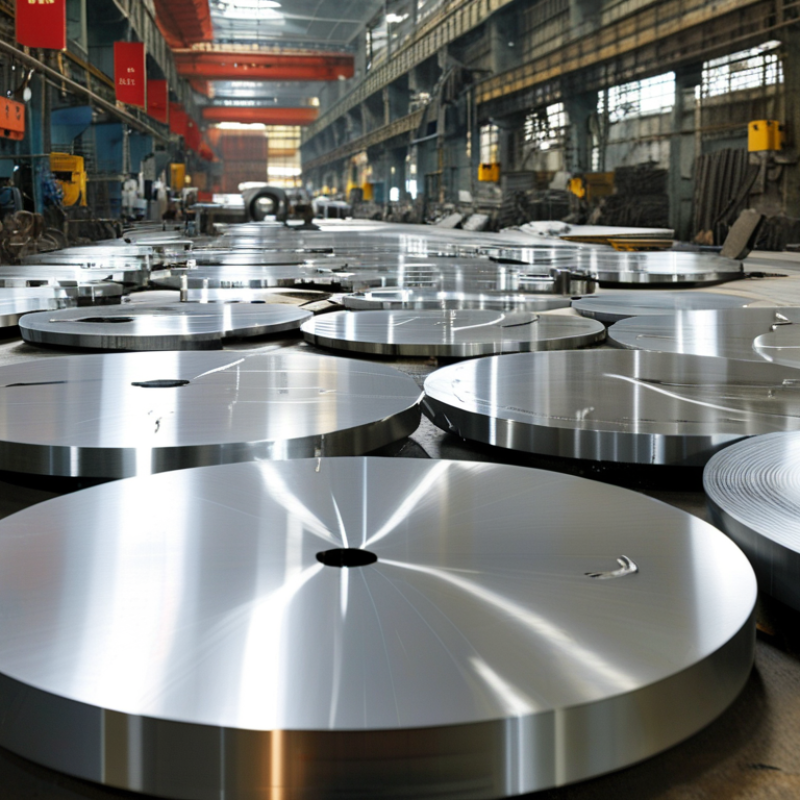
Carbon steel discs are flat, round components cut from carbon steel plate, sheet, or coil. Their carbon content provides strength, stiffness, and affordable machinability. Common grades include low-carbon steel for forming and medium-carbon steel for wear-resistant parts. Discs can become pipe caps, pressure-vessel blanks, machine covers, pulleys, flanges, and structural fittings. They are also used in stamping and fabrication lines.
Demand is linked to the wider steel industry. The World Steel Association reported about 1.89 billion tonnes of crude steel production in 2023. The International Energy Agency states that steelmaking creates roughly 7% of global energy-related emissions. These figures do not describe carbon steel discs alone. They show why responsible manufacturers now track scrap recovery, energy use, and material traceability. In practice, buyers should review thickness tolerance, flatness, edge quality, hardness, and heat-lot records. Standards such as ASTM and EN specifications help compare products across suppliers. Still, certificates are not perfect. Independent inspection may reveal coating damage, lamination, or uneven cutting.
Tips: Match the disc grade to its service conditions. Check corrosion exposure, load cycles, forming depth, and operating temperature. Laser cutting suits precise thin discs, while plasma or flame cutting may fit thicker sections. Ask for a dimensional report and test certificate. A small sample run is wiser than trusting a catalogue image. Erot despre mistake? Actually avoid weird. A common mistake is choosing by diameter and price alone. Surface condition can decide whether the disc performs reliably.
Evaluating China’s carbon steel disc manufacturers requires more than comparing quotations. China produced about 1,005 million tonnes of crude steel in 2024, representing roughly half of global output, according to the World Steel Association. This scale supports strong supply chains, but volume does not guarantee stable disc quality.
Request mill certificates for every heat, including carbon, manganese, sulfur, phosphorus, and tensile results. The certificate should match the actual batch number, not a generic template.
A practical audit should examine forging temperature records, heat-treatment curves, machining tolerances, and ultrasonic inspection reports. Ask how rejected discs are isolated. Small details matter.
For example, a 0.3 mm thickness deviation may affect fit, vibration, or service life in rotating equipment.
Verify testing against applicable ASTM, EN, or ISO requirements, then confirm the laboratory’s calibration records. ISO 9001 certification is useful, yet it proves a management system, not automatic product excellence.
The ISO Survey 2023 recorded more than 790,000 ISO 9001 certificates in China, showing broad adoption but not equal technical performance.
Request recent third-party inspection results and customer reference projects with comparable diameter, grade, and loading conditions. Factory visits remain valuable; photographs can hide workflow weaknesses.
I would also check packing, rust prevention, and traceability after machining. These points are often overlooked.
A reasonable evaluation should include sample testing before a large order, because even a polished supplier profile can leave unanswered questions.
China’s top 10 carbon steel disc manufacturers serve pressure vessels, valves, flanges, and industrial machinery. Their products commonly use carbon steel grades such as Q235, Q345, A516, or equivalent international materials. A reliable manufacturer should provide heat numbers, mill certificates, dimensional reports, and traceable inspection records.
The strongest suppliers usually operate forging, cutting, heat treatment, and machining equipment in one facility. This reduces handling risks and improves production control. Buyers should examine disc thickness, outside diameter, surface condition, and flatness before approval. Ultrasonic testing can reveal internal flaws that visual checks may miss. Welding procedures, hardness results, and packaging methods also deserve attention.
Factory experience matters. An experienced engineering team can adjust processes for thick discs, tight tolerances, and repeated orders. Export knowledge is useful when documents must match different technical standards. Still, no manufacturer is perfect. A supplier may offer excellent machining but weaker packaging control. Another may deliver quickly but provide limited inspection evidence. That is why the top 10 carbon steel disc manufacturers in China should be compared through samples, audits, production photos, and independent testing. Ask difficult questions. Review the answers carefully. Small gaps often become costly problems during installation.
China’s leading carbon steel disc manufacturers supply blanks for flanges, pressure equipment, machinery, and structural assemblies. Common products include round discs, ring blanks, perforated plates, and custom-cut components. Diameters may range from small workshop parts to heavy industrial plates several meters wide.
Material selection usually includes carbon steel grades such as Q235, Q345, ASTM A36, A105, and A516. The correct grade depends on strength, temperature, pressure, and forming requirements. Manufacturers may use hot-rolled or cold-rolled plate, followed by plasma cutting, laser cutting, or CNC machining. Details matter. Edge quality affects later welding and fitting.
Reliable factories provide mill certificates, heat numbers, chemical analysis, and mechanical test results. Many also perform ultrasonic testing, dimensional inspection, hardness checks, and surface evaluation. Heat treatment can improve stress relief and stability, while shot blasting and rust protection support export handling. Tolerance varies. A polished catalog does not prove consistent production. Buyers should compare sample reports, inspection photos, packaging methods, and actual delivery records. In practice, some suppliers communicate quickly but document poorly; others produce accurately but need clearer drawings. That gap matters when discs require strict flatness, concentricity, or repeatable thickness.
| Rank | Manufacturer Profile | Key Disc Products | Common Carbon Steel Materials | Typical Size Capability | Manufacturing Processes | Applicable Standards | Surface and Heat Treatment | Quality and Testing Capabilities | Typical Applications |
|---|---|---|---|---|---|---|---|---|---|
| 1 | Profile 01 Heavy-duty producer |
Flame-cut discs, hot-rolled steel discs, structural blanks, base plates | Q235B, Q355B, ASTM A36, S235JR, S355JR | Diameter: 200–3,500 mm Thickness: 6–120 mm |
CNC plasma cutting, oxy-fuel cutting, turning, drilling, edge chamfering | GB/T 700, GB/T 1591, ASTM A36, EN 10025-2 | Shot blasting, primer coating, stress relieving when specified | Dimensional inspection, chemical analysis, tensile testing, ultrasonic testing on request | Construction machinery, steel structures, tanks, industrial equipment |
| 2 | Profile 02 Precision blank specialist |
Laser-cut discs, precision round blanks, flanges, machined discs | Q235, Q355, 1018, 1020, 1045, S275JR | Diameter: 20–1,800 mm Thickness: 1.5–50 mm |
Fiber-laser cutting, CNC turning, milling, deburring, dimensional finishing | GB/T 700, EN 10025-2, ASTM A29, ASTM A36 | Black mill finish, pickling, oiling, shot blasting, black oxide where suitable | Coordinate measurement, hardness testing, visual inspection, material certificates | Automation equipment, mechanical parts, agricultural machinery |
| 3 | Profile 03 Forged-disc producer |
Forged carbon steel discs, hub blanks, pressure-bearing round forgings | C45, C50, 1045, 1050, 40Cr, 42CrMo | Diameter: 100–2,000 mm Thickness: 20–300 mm |
Open-die forging, ring rolling, normalizing, rough machining | EN 10083-2, ASTM A29, ASTM A668, GB/T 699 | Normalizing, annealing, quenching and tempering according to grade | Ultrasonic testing, tensile testing, impact testing, hardness mapping, macrostructure inspection | Power transmission, mining equipment, heavy machinery, pressure equipment |
| 4 | Profile 04 Flange and ring supplier |
Blank discs for flanges, blind flange blanks, retaining rings, pipe-component blanks | Q235B, Q355D, A105, A350 LF2, P245GH | Outside diameter: 50–3,000 mm Thickness: 5–250 mm |
Hot forging, ring rolling, CNC turning, bolt-hole drilling | ASME B16.5, ASME B16.47, EN 1092-1, ASTM A105, ASTM A350 | Heat treatment, rust preventive oil, shot blasting, corrosion-protection coating | Positive material identification, dimensional inspection, magnetic-particle testing, hydrotest support | Petrochemical piping, water treatment, power generation, process plants |
| 5 | Profile 05 Laser-cutting specialist |
Thin and medium-gauge discs, washer blanks, cover plates, circular panels | Q235B, Q355B, ASTM A36, S235JR, S355JR | Diameter: 30–2,500 mm Thickness: 2–40 mm |
Fiber-laser cutting, CNC plasma cutting, countersinking, tapping, deburring | ISO 9001 production controls, GB/T 700, EN 10025-2, ASTM A36 | As-cut, deburred, brushed, powder-coated or wet-painted after fabrication | Laser calibration, profile measurement, edge-quality inspection, batch traceability | Enclosures, ventilation systems, conveyors, machinery guards |
| 6 | Profile 06 Machined-disc supplier |
Turned discs, keyed discs, grooved discs, gear and pulley blanks | C45, C50, 1045, 1020, 40Cr | Diameter: 50–1,600 mm Thickness: 5–180 mm |
CNC turning, milling, keyway cutting, drilling, balancing, grinding | GB/T 699, EN 10083-2, ASTM A108, ASTM A29 | Normalizing, induction hardening, quenching and tempering, black oxide | Runout measurement, surface roughness testing, hardness testing, dynamic balancing | Motors, reducers, pumps, conveyors, agricultural and factory equipment |
| 7 | Profile 07 Structural-steel fabricator |
Base discs, anchor plates, support plates, foundation discs, connection blanks | Q235B, Q355B, Q355C, S275JR, S355JR | Diameter: 200–4,000 mm Thickness: 8–100 mm |
Plate cutting, CNC drilling, welding, straightening, shot blasting | GB/T 700, GB/T 1591, EN 10025-2, AWS D1.1 when welding is required | Shot blasting to specified cleanliness, zinc-rich primer, epoxy or polyurethane coating | Weld visual inspection, dimensional checks, coating-thickness testing, ultrasonic testing | Steel buildings, bridges, towers, renewable-energy structures |
| 8 | Profile 08 Industrial plate processor |
Boiler discs, vessel blanks, inspection covers, manway blanks | Q245R, Q345R, P235GH, P265GH, ASTM A516 Grade 60/70 | Diameter: 300–3,200 mm Thickness: 8–150 mm |
Plate rolling support, CNC cutting, forming, machining, heat treatment coordination | GB/T 713, EN 10028-2, ASTM A516/A516M, EN 13445 project requirements | Normalizing, stress relieving, shot blasting, primer or temporary corrosion protection | Ultrasonic testing, tensile and impact testing, hardness testing, heat-number traceability | Boilers, pressure vessels, heat exchangers, storage tanks |
| 9 | Profile 09 Custom export manufacturer |
Custom carbon steel discs, OEM blanks, replacement discs, fabricated circular parts | Q235B, Q355B, A36, S235JR, C45, 1045 | Diameter: 25–3,000 mm Thickness: 2–200 mm |
Laser and plasma cutting, turning, drilling, welding, assembly and packing | Customer drawings, GB/T, ASTM, EN and JIS material requirements | Oiled, painted, galvanized where applicable, VCI or export seaworthy packing | Inspection plans, mill certificates, first-article inspection, final inspection reports | OEM machinery, replacement parts, infrastructure projects, international sourcing |
| 10 | Profile 10 Small-batch and prototype producer |
Prototype discs, low-volume blanks, test components, custom mounting plates | Q235, Q355, 1020, 1045, C45, S355JR | Diameter: 10–1,200 mm Thickness: 1–80 mm |
Waterjet cutting, laser cutting, CNC turning, milling, rapid tooling | GB/T 700, EN 10025-2, ASTM A36, ASTM A29 | Deburring, brushing, oiling, black oxide, local heat treatment when specified | Prototype dimensional reports, hardness testing, visual inspection, material verification | Research equipment, product development, robotics, maintenance and repair |
| Capability ranges are representative of commonly available Chinese carbon steel disc manufacturing services. Actual dimensions, grades, tolerances, heat treatment, testing and certifications depend on the approved drawing, purchase specification and production facility. | |||||||||
Choosing among China’s top carbon steel disc manufacturers requires more than comparing prices. The World Steel Association reported China’s crude steel output at about 1.02 billion tonnes in 2023. This scale supports strong production capacity, but capacity does not guarantee consistent discs. Ask for material certificates, heat-treatment records, dimensional reports, and full batch traceability. For pressure-related parts, confirm the required grade, testing method, and applicable standard before requesting quotations.
Evaluate the factory, not only its catalogue. Review equipment age, forging or cutting capability, machining tolerance, and inspection staffing. ISO 9001 certification can support process control, but it is not proof of product quality. Request recent sample reports and arrange independent inspection before shipment. The International Energy Agency notes that iron and steel production creates roughly 8% of global energy-related carbon dioxide emissions. Therefore, energy records and recycled-content data may reveal a supplier’s operational maturity. I would not rely on polished photographs alone.
Tips: Send a precise drawing with tolerances, surface requirements, and packaging details. Compare at least three quotations on the same specification. Check response speed and technical questions. A cheap offer may hide weaker testing or higher rejection risk. No checklist is perfect. Leave room for a pilot order, because real production often exposes assumptions that paperwork misses.